
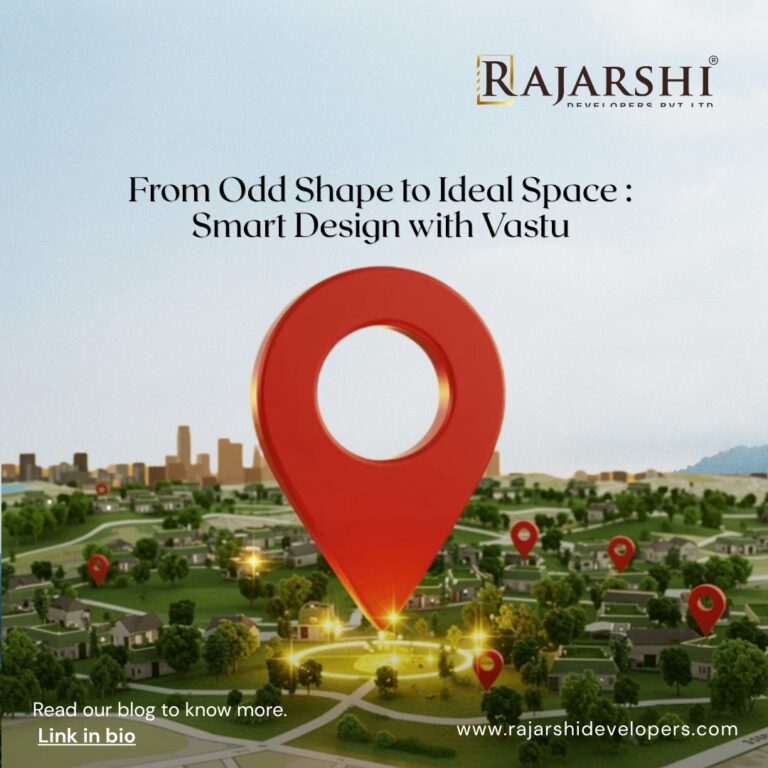
Odd-Shaped Plots in India: Smart Design & Vastu Planning Guide
Odd-Shaped Plots in India: Smart Design & Vastu Planning Guide
Discover how odd-shaped plots in cities like Bengaluru, Mumbai, and Chennai can be transformed into design opportunities. Learn practical strategies for maximising space, light, sustainability, and property value on irregular land parcels.
Why Plot Shape Should Not Define Your Ambitions
When searching for land or planning a home, most buyers instinctively gravitate toward rectangular plots — straightforward, predictable, and easy to work with. Plots that taper, angle, or follow irregular boundaries tend to be dismissed before they are even considered seriously.
This hesitation, however, is rooted more in assumption than in architectural reality.
In fast-expanding urban centres such as Bengaluru, Mumbai, and Chennai, road-widening projects, metro alignments, and infrastructure developments regularly produce plots that deviate from conventional geometry. Rather than viewing these as defects, progressive architects and informed property buyers are increasingly recognising them as design opportunities waiting to be unlocked.
The core idea is straightforward: an odd-shaped plot is not a constraint — it is a unique design brief.
1. What Qualifies as an Odd-Shaped Plot?
An odd-shaped plot is any parcel of land whose boundary does not conform to a simple rectangle or square. Variations include:
- Triangular plots — often found at road intersections
- Trapezoidal plots — one side wider than the other
- L-shaped plots — naturally forming internal voids or courtyards
- Tapered plots — wider at one end, narrowing towards the other
- Curved-edge plots — influenced by roads or natural features
- Irregular boundary plots — arising from land subdivision or inheritance divisions
These configurations are a natural outcome of urban planning, infrastructure growth, and generational land transfers. They are not design flaws; they are real-world conditions.
2. Rethinking the "Rectangular is Best" Assumption
The widespread preference for rectangular plots is understandable. They simplify structural grids, make furniture arrangement more intuitive, and feel inherently organised.
However, symmetry is not the same as superiority.
In architecture, working within constraints frequently produces more creative, responsive, and memorable outcomes than working on a blank canvas. The globally recognised Flatiron Building in New York City is a compelling reference point. Situated on a triangular plot formed by the convergence of two major streets, the building’s unusual geometry — far from being a liability — became its defining characteristic. Today, it stands as one of the most photographed and architecturally celebrated structures in the world.
The principle is clear: irregular geometry, thoughtfully handled, can become a building’s greatest asset.
3. Smarter Space Planning Through Site-Specific Zoning
Conventional rectangular plots often encourage a formulaic approach to space planning — rooms arranged in predictable grids with little consideration for how light, wind, or human behaviour interact with the layout.
Irregular plots, by contrast, demand more deliberate thinking.
Architects working on odd-shaped sites typically conduct detailed analyses of:
- Solar orientation — identifying which directions receive morning, afternoon, and evening sun
- Prevailing wind patterns — positioning openings to encourage natural ventilation
- Access and movement — understanding how people will enter and circulate through the space
- Privacy gradients — separating public-facing zones from private living areas
This analysis-first approach often produces more functional and contextually appropriate layouts than standard box planning. A tapered end, for instance, can house a staircase, compact storage, or a powder room. An angular corner might become a dedicated reading nook or a home workspace. An L-shaped boundary can naturally define a private courtyard.
The discipline of designing with the land — rather than imposing a template onto it — leads to spaces that are both more efficient and more considered.
4. Superior Daylighting and Natural Ventilation
One of the most tangible benefits of irregular plot shapes is the potential for enhanced environmental performance.
Because the building footprint is shaped by the boundary rather than by a standard template, more wall surfaces can be oriented toward open space, external air, and natural light. This translates into:
- Increased daylight penetration across interior rooms
- Improved cross-ventilation through strategically positioned openings
- Reduced heat gain through responsive façade design
This is particularly relevant in climatic zones like Chennai and coastal Karnataka, where passive cooling strategies are critical to habitation comfort. Irregular plots sometimes allow better wind alignment than rigidly oriented rectangular sites that happen to face less favourable directions.
Modern architecture increasingly prioritises site-responsive, climate-conscious design. Odd-shaped plots are natural allies of this approach.
5. The Courtyard Advantage
L-shaped and corner plots frequently create internal voids or semi-enclosed spaces. Rather than treating these as leftover areas, skilled design transforms them into purposeful features:
- Shaded courtyard gardens
- Light wells bringing daylight to interior rooms
- Semi-open verandahs or sit-out zones
- Water features and landscape accents
Courtyard planning has deep roots in Indian vernacular architecture. It addresses ventilation, thermal comfort, social interaction, and daylighting in a single spatial move. Irregular plots often generate these voids organically — which is an advantage, not a problem.
6. Architectural Identity and Market Differentiation
In competitive real estate markets like Bengaluru and Pune, properties that stand out visually tend to attract stronger buyer interest and command better resale premiums.
A home designed around a triangular or curved boundary carries an inherent visual distinctiveness that a standard rectangular house rarely achieves. This distinctiveness has practical consequences:
- Stronger recall value among prospective buyers
- Greater appeal in resale listings and rental markets
- Enhanced brand identity for commercial developments occupying irregular sites
As buyers become more design-conscious, properties that demonstrate architectural thoughtfulness — rather than template repetition — are increasingly sought after.
7. Creative Possibilities in Interior Design
The interior of a home designed on an irregular plot tends to offer a richer spatial experience than its rectangular counterpart.
Angular boundaries naturally introduce:
- Angled feature walls that draw the eye and define zones
- Bay-style window recesses ideal for seating or study
- Double-height corner volumes that add drama and light
- Split-level arrangements that respond to the changing geometry
Interior designers often find irregular geometries more stimulating to work with. These spaces photograph with greater depth and dynamism, and they tend to feel more memorable to occupants and visitors alike.
8. Structural Feasibility: Addressing Common Misconceptions
A frequently cited concern about irregular plots is that construction becomes technically difficult and disproportionately expensive. This is largely a misconception.
Contemporary structural engineering accommodates irregular footprints with relative ease. Both reinforced cement concrete (RCC) and structural steel systems allow flexible column placement and can be configured to suit non-standard boundaries. Load distribution strategies are designed to adapt to the specific geometry of the site.
In many well-planned projects on irregular sites, costs remain comparable to those on regular plots. In certain cases, a building that closely follows the boundary actually reduces waste — there are fewer unusable strips of land and less material lost to inefficient planning.
Construction costs are more directly influenced by planning quality than by plot shape.
9. Greater Open Space and Landscape Opportunities
Odd-shaped plots often result in staggered setbacks and layered site planning. This can yield:
- Larger landscaped buffers around the structure
- Segregated utility zones that do not impinge on living areas
- Dedicated outdoor activity spaces
- Privacy buffers between the building and adjacent properties
In dense urban contexts where usable open space is at a premium, these qualities translate directly into lifestyle value.
10. Vastu Considerations on Irregular Plots
Irregular plots attract considerable scepticism in traditional Vastu discourse. However, a growing number of contemporary Vastu consultants and architects advocate a principle-based rather than geometry-based interpretation of the discipline.
Key functional aspects — entrance placement, kitchen and bedroom orientation, open-space distribution, and alignment with cardinal directions — can all be addressed through careful planning, even on irregular sites.
Rather than dismissing an irregular plot outright on Vastu grounds, the more productive approach is to commission a layout that accommodates both environmental logic and traditional principles. Many successful homes have achieved precisely this.
11. Investment Potential: The Undervalued Opportunity
Odd-shaped plots are frequently undervalued in the market. Because they are less immediately appealing to buyers without design expertise, they often sell at lower per-square-foot rates than comparable rectangular plots in the same locality.
For informed buyers, this creates a meaningful acquisition advantage:
- Lower initial cost relative to location
- Reduced competition during purchase
- Significant upside once the property is well-designed
Once a thoughtfully designed home or commercial space is built on an irregular site, it typically commands a premium — not despite its shape, but because of what that shape enabled the design to become.
12. Alignment With Sustainable Architecture Principles
Sustainable architecture is fundamentally about responsiveness to place. It is not defined by symmetry or standardisation.
Irregular plots support sustainable design in several direct ways:
- Façades can be oriented to maximise or minimise solar exposure depending on the climate
- Openings can be aligned with prevailing breezes to support passive ventilation
- Rainwater harvesting areas can be positioned in the site’s natural low points
- Structural setbacks can create natural shading for walls and windows
Global architectural practice increasingly values buildings that grow out of their specific context. Odd-shaped plots encourage exactly this kind of thinking.
13. Human Experience in Non-Linear Spaces
Research in environmental psychology suggests that spatial variety positively influences how people feel within a built environment. Spaces that shift in proportion, height, and orientation tend to foster greater engagement and a stronger sense of place than uniformly repetitive environments.
In residential settings, this translates into a home that feels alive, layered, and personally meaningful. In commercial settings, it contributes to brand memorability and customer experience.
Irregular geometry, far from being unsettling, can be a powerful tool for creating spaces that people enjoy inhabiting.
14. The Right Approach: Designing With the Land
The single most important shift in perspective for anyone working with an odd-shaped plot is this: stop trying to correct the shape, and start designing with it.
This requires:
- Thorough site analysis — understanding all physical attributes of the plot
- Solar and wind studies — mapping environmental conditions throughout the day and year
- Traffic and access assessment — understanding movement patterns around the site
- Strategic programme zoning — assigning uses to areas based on their suitability
- Custom structural planning — developing a structural system that serves the layout
When this process is followed rigorously, the plot’s irregular geometry becomes part of the architectural solution rather than an obstacle to it.
15. Case Insight: Urban Triangular and Tapered Sites
Across densely developed city grids, residual triangular plots at junctions and tapered parcels along curved roads are common. In cities worldwide, these sites are routinely developed into boutique commercial spaces, compact residences, and neighbourhood landmarks.
Their unusual configurations, once addressed by a skilled architect, often make them more distinctive and commercially successful than their rectangular neighbours. The geometry becomes the identity.
16. Cost Realities vs. Perceived Risk
Perception: Irregular plots are significantly more expensive to build on.
Reality: Cost outcomes depend primarily on how well the design is planned, not on whether the plot is regular or irregular.
A well-resolved design on an irregular site will:
- Optimise the structural grid to the available boundary
- Eliminate dead circulation space
- Use materials efficiently by minimising waste
- Produce a building that fills and activates the entire site
Conversely, a poorly planned design on a rectangular plot can waste significant area and inflate costs. Shape is rarely the determining variable; planning quality is.
17. Future Relevance: Urban Density and Site Flexibility
As Indian cities continue to densify, large rectangular plots in accessible urban locations are becoming increasingly rare. Infrastructure development, road realignment, and subdivision patterns will continue to generate irregular parcels across metropolitan areas.
Homeowners, investors, and developers who can confidently engage with complex site conditions will have a competitive advantage. The ability to see potential in an unconventional plot is not just a design skill — it is a strategic asset.
Conclusion: Irregular by Boundary, Extraordinary by Design
An odd-shaped plot invites a more rigorous, more contextual, and ultimately more rewarding approach to design. It asks you to study the land, understand its environment, respond to its specific conditions, and create something that could exist only in that place.
History and contemporary practice consistently demonstrate that some of the most admired and valuable built environments arise from unconventional sites. The constraint, handled well, becomes the character.
If you own or are considering an irregular plot, the most important step is to engage an architect who understands site-responsive design — and to approach the process with curiosity rather than apprehension.
What appears irregular on a land survey can become extraordinary on the ground.
Planning a home or development on an irregular plot? Consult an experienced professional with a portfolio of site-specific residential and commercial projects.
Recent Posts