
Namma Banaglore Metro extending from KR Puram to Hoskote?
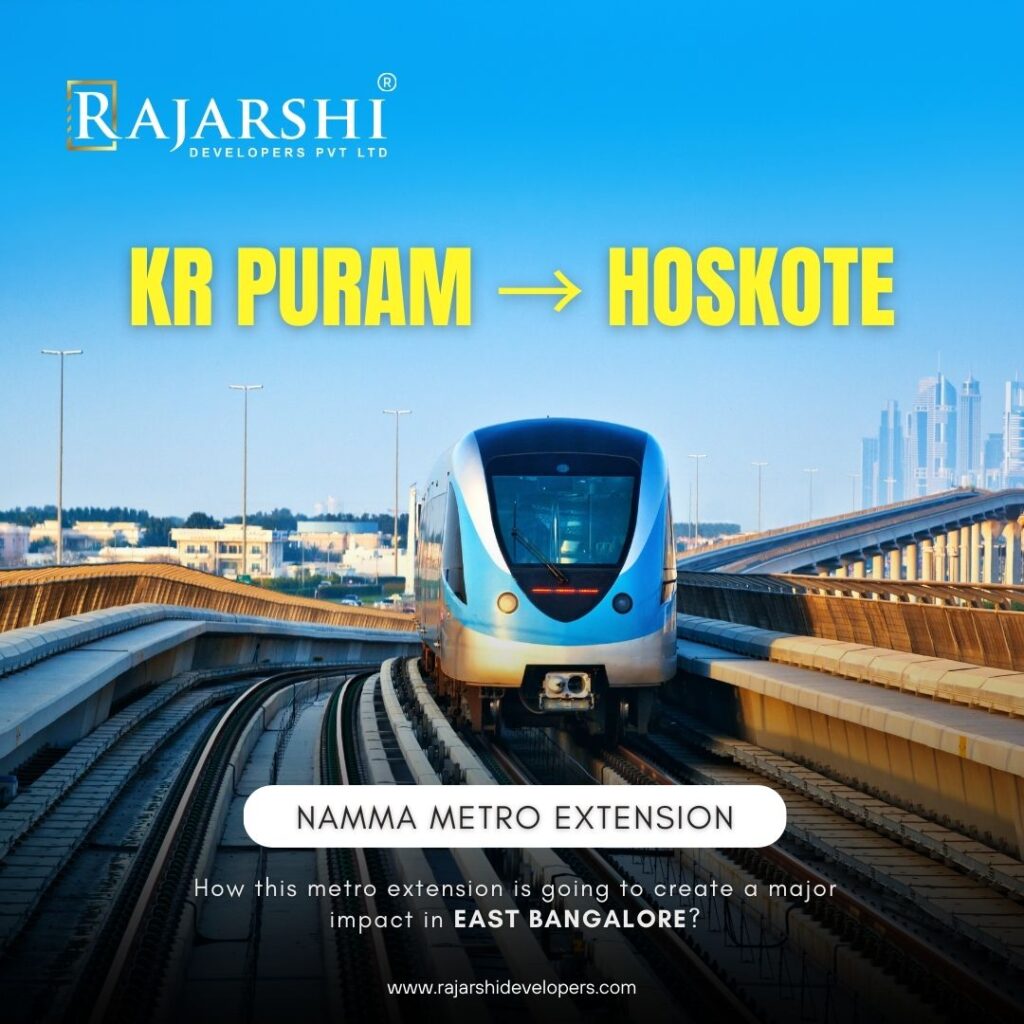
Namma Banaglore Metro extending from KR Puram to Hoskote?
Bengaluru — India’s Silicon Valley, the city that never stops evolving — is once again on the brink of a transformative leap in urban mobility. As traffic snarls, real estate booms, and the city’s footprint stretches ever outward, the Namma Metro, Bengaluru’s lifeline in mass rapid transit, is being reimagined yet again. This time, the spotlight is on a bold proposal that could redefine connectivity in the eastern outskirts of the city: a metro extension from KR Puram to Hoskote.
More than just brick, steel, and rails, this is about reshaping travel, accelerating economic growth, and knitting the city more seamlessly with its suburban and rural edges. Stay with us as we dive deep — in an engaging, fact-driven, and captivating journey – into what this project is, why it matters, the unique design ideas on the table, and what it could mean for the future of Bengaluru.
Why Hoskote? Why Now?
If you’ve ever sat in bumper-to-bumper traffic on Old Madras Road (NH-75) — especially between KR Puram and Hoskote – you know that Bengaluru’s eastern corridor is one of its most congested stretches. Thousands of commuters travel daily along this road for work, education, and business. Yet, despite fast development — offices, tech parks, logistics hubs and residential townships, this zone remains poorly served by high-capacity public transport.
Today, Hoskote does not have a metro station. The nearest Metro access points for people here are Whitefield (Kadugodi), Hopefarm, and KR Puram stations, often forcing long commutes by road just to reach the rail network.
What’s changing in planners’ minds.
In the wake of rapid urban expansion eastwards — fuelled by real estate growth, industrial zones, and new infrastructure such as the Bengaluru–Chennai Expressway and Satellite Ring Road — BMRCL (the Bangalore Metro Rail Corporation Ltd) has begun studying ways to extend metro connectivity to Hoskote, about 15–16 km from the existing KR Puram terminal.
So why this stretch?
- Growing Population and Commuter Demand
Hoskote and the surrounding belt have exploded in residential and commercial activity. With rising housing developments, education institutions, and employment centers, the daily commuter count is rising fast — and existing road transport is no longer sufficient.
- Congestion and Lost Time
Old Madras Road — one of Bengaluru’s busiest arterial roads — sees heavy traffic all day long. A direct metro link would allow thousands to bypass this congestion entirely, shaving hours off travel time and reducing road stress significantly.
- Regional Integration
Bringing Hoskote closer to the metro network doesn’t just help local commuters — it links key economic zones, boosts trade movement, and connects rural Karnataka more effectively to Bengaluru’s urban core
Strategic Location Advantage: Beyond Hoskote – Toward Malur
While the extension is planned up to Hoskote, its impact extends much further.
Hoskote sits strategically between Bengaluru and Malur, a fast-growing town emerging as a residential and industrial hotspot. Improved metro connectivity up to Hoskote could:
- Improve commute access for Malur residents
- Boost land and plot demand in Malur
- Strengthen the Bengaluru–Malur investment corridor
- Enhance connectivity to the Bengaluru–Chennai Expressway
For real estate investors and homebuyers, this infrastructure move could significantly enhance long-term appreciation potential in Malur and surrounding areas.
What’s On the Table: The Metro Proposal Explained
Let’s talk about what exactly is being proposed — because this isn’t your regular metro line. The plan currently being studied is far more innovative and ambitious than a simple elevated extension.
The KR Puram – Hoskote Stretch: Approximately 15–16 km
According to official and credible reports, BMRCL is evaluating a metro corridor extension of around 16 km from KR Puram to Hoskote, potentially as part of the Pink Line (or Purple Line) extension.
The feasibility for this alignment is currently being assessed by Delhi-based Introsaptt Solutions Pvt Ltd, tasked with technical viability, cost estimates, optimal station locations, traffic impact analysis and environmental sustainability studies. Once that’s complete, a Detailed Project Report (DPR) will be prepared.
What Makes This Project Unique: The Double-Decker Concept
Here’s where this project gets truly fascinating.
Instead of a traditional single-level metro alignment, planners are exploring a double-decker corridor — a smart integration of a metro line above a roadway (or vice versa), effectively combining two transportation modes in one vertical space.
Why Double-Decker?
- Optimised use of limited land – Bengaluru’s built-up and congested corridors make additional land acquisition costly and complicated.
- Reduced civil disruptions – Building up and over existing roads could minimise disruption to traffic and businesses below.
- Dual infrastructure in one footprint – A metro rail system and a vehicular flyover share vertical space, reducing the need for separate structures.
In cities like Tokyo and Shenzhen, similar multi-level transit infrastructure has helped reduce congestion and enhance mobility without sprawling the urban footprint outward.
If executed successfully in Bengaluru, the KR Puram – Hoskote corridor could be India’s first metro link to combine a rail line and elevated road in a single integrated system — a pioneering idea with potential to become a national model.
Where the Metro Might Stop: Possible Station List
While the final alignment and station locations will be confirmed only after the DPR is prepared, early reports and feasibility studies suggest the corridor could include stations at:
- KR Puram
- ITI Bhavan
- TC Palya Gate
- Battarahalli
- Medahalli
- Avalahalli
- Budigere Cross
- Katamnallur Gate Flyover
- Hoskote Toll Plaza
- KEB Circle
- Government Hospital Area, Hoskote
This sequence shows how the metro link may not just serve Hoskote town itself, but also critical growth nodes along the corridor — many of which are currently underserved by rapid transit.
How This Fits in Bengaluru’s Broader Metro Expansion Plan
Now let’s zoom out and see the bigger picture.
Phase 2 and 3
Namma Metro’s Phase 2 and Phase 3 have already expanded the network significantly, adding routes such as the Whitefield (Kadugodi) – KR Puram link and extensions on the Green, Yellow and Purple Lines.
The Whitefield – KR Puram segment itself became operational in March 2023, providing a key east-west link and relieving congestion on Old Madras Road.
Where KR Puram – Hoskote Fits
Rather than being part of the original Phase 2 or 3 plans, the KR Puram – Hoskote line emerges out of newer expansion ideas and is part of longer-term visions often referred to in planning circles as Phase 4 or Metro Master Plan 2031 corridors.
In fact, the BMRCL feasibility study of 197 km corridors under consideration includes the KR Puram – Hoskote stretch (15 km) among other possible extensions.
This underscores that while the idea is approved in principle for study, it has not yet reached implementation — a critical distinction we’ll explore next.
Status Check: Where the Project Currently Stands
At the time of writing:
Feasibility Study Underway
BMRCL has commissioned feasibility analysis for the metro extension from KR Puram to Hoskote. The objectives include:
- Technical feasibility of the double-decker design
- Project cost estimates
- Traffic flow and station placement research
- Environmental and social impact assessments
Detailed Project Report (DPR) Pending
Once feasibility is complete, a DPR will be prepared, which forms the basis for:
- Cost finalization
- Central and State Government approvals
- Funding allocation
- Land acquisition planning
- Construction timeline and tendering
This means construction has not begun yet. It is still in the planning and approval phases — a phase that can take over a year or more before physical work begins.
The Good, the Bad, and the Complex
As with all infrastructure mega projects, the KR Puram – Hoskote metro proposal is surrounded by optimism — and real challenges.
Why This Project Excites Many
- Reduced commute times – Long road journeys between Bengaluru and Hoskote could shrink dramatically.
- Environmental benefit – Fewer cars on the road could reduce emissions and improve air quality.
- Catalyst for growth – Businesses and real estate could benefit from better connectivity.
- Urban-rural integration – It brings suburban and rural edges closer to the city’s central opportunities.
Challenges and Critical Considerations
- Planning and approval delays:
Even past Namma Metro extensions have seen delays — Phase 2, for example, was originally planned for completion years earlier but saw overruns due to multiple factors like land acquisition, pandemic disruptions, and contractual issues. - Cost and funding:
Building metro infrastructure is capital-intensive. While metro boosts productivity, funding decisions require careful budget planning from both state and central governments. - Actual ridership projection:
Forecasting commuter numbers — essential for financial viability — is complex for regions still evolving in demographics and economic activity. - Integration with other transit systems:
Connectivity with buses, suburban rail and future rapid transit systems needs to be part of a seamless network, not a standalone corridor.
Voices from the Ground: What Residents and Commuters Say
While official reports paint one picture, public reaction is mixed – as is typical with major infrastructure proposals:
- Some residents and commuters express strong enthusiasm, believing that metro connectivity will be a game changer for daily life, traffic decongestion, and economic opportunities.
- Others on forums have voiced scepticism — pointing to slow project timelines in the past and cautioning that “plans on paper” often take years to materialize.
Both perspectives highlight a real truth: people want better transit solutions, but they also want visible progress.
What Happens Next? The Road Ahead
Here’s what we can reasonably expect in the coming months and years:
Completion of Feasibility Study
This is the immediate next step. Once complete, it will decide:
- Whether the double-decker corridor is technically feasible
- The most efficient station placements
- Expected capital costs and phasing
Preparation of a Detailed Project Report (DPR)
The DPR is the blueprint that determines whether the project is financially and operationally viable.
Government Approvals
State and Central Government approvals are essential — and often tied to budget sessions and priority alignment with broader city planning.
Land Acquisition and Tendering
Only after approvals can land acquisition start — one of the most time-consuming aspects of major transport infrastructure in India.
Construction
If all approvals and funding align, construction could begin — but realistically, this is likely several years away, with phased completion timelines extending into the late 2020s or early 2030s.
Final Thoughts: A Vision Worth Watching
The KR Puram to Hoskote metro extension isn’t just another proposed rail line. It’s a vision for a future Bengaluru — one where connectivity extends beyond old city limits, where growth corridors are served by efficient, high-capacity transit, and where daily commutes are less about frustration and more about productivity and comfort.
It stands at the intersection of practicality and innovation: supported by feasibility studies, championed by planners, and eagerly anticipated by communities. While it still faces hurdles and uncertainties, the momentum behind this project reflects a broader shift in how Bengaluru is grappling with urbanization — tackling it not by widening roads alone, but by reimagining mobility itself.
If it becomes a reality, it could well be one of the defining infrastructure achievements of the decade, shaping how millions travel, work, live, and grow in this vibrant metropolis.
Recent Posts